 Ask The Home Geek
LED lighting is one of the easiest ways to change how your bedroom looks and feels. A warm glow behind the headboard, soft light under the bed, or a reading lamp that dims at the tap of an app can make the room cozier and more practical, and help you wind down at night.
Here's how to choose the right LED lights for your bedroom, where to put them, how to install strip lights, and how to set them up so they help your sleep rather than hurt it.
Why Use LED Lights in Your Bedroom?
- Lower energy use: LEDs use far less electricity than old incandescent bulbs for the same amount of light. A typical LED bulb uses about a sixth of the power, which cuts your lighting costs.
- Long life: Good-quality LED bulbs are often rated for 15,000–25,000 hours or more, so you'll rarely need to replace them.
- Little heat and no UV: LEDs run cool and give off almost no UV light, so they're comfortable to sit near and won't fade fabrics or artwork the way some older lights can.
- Flexibility: You can dim them, adjust them from warm to cool white, change their color, and control them with your phone or voice, all from one light source.
- Instant full brightness: Unlike some older energy-saving bulbs, LEDs come on at full brightness right away.
You can see this 100-foot KSIPZE LED strip on Amazon, or shop for smart bulbs and lamps from most lighting brands.
How to Choose the Right LED Lights for Your Bedroom
Brightness (lumens)
Brightness is measured in lumens, not watts. As a rough guide:
- An LED bulb with about 800 lumens gives roughly the same light as an old 60-watt bulb.
- A typical bedroom needs about 1,500–4,000 lumens in total from all its lights, depending on the size of the room and how you use it.
- Bedside reading lamps work well at about 400–800 lumens each.
It's better to have several dimmable lights than one very bright ceiling light.
Color temperature (Kelvin)
Color temperature describes how warm or cool white light looks:
- 2700K–3000K (warm white): a cozy, relaxing light. Best for bedrooms, especially in the evening.
- 3500K–4000K (neutral white): cleaner and brighter. Good for a desk area, a dressing area, or a closet.
- 5000K and above (daylight): crisp and bluish. Usually too harsh for a bedroom at night.
Tunable white bulbs and strips let you switch between warm and cool white, for example cooler and brighter in the morning, and very warm in the evening.
Dimming
Choose lights you can dim, whether with a compatible dimmer switch, a smart bulb, or a strip with a controller. Being able to lower the light in the evening makes a big difference to how relaxing the room feels. If you use a wall dimmer, make sure the bulbs are labeled "dimmable" and the dimmer is LED-compatible, or the lights may flicker or buzz.
Energy use
LEDs are very efficient, which is why LED lights don't use much electricity compared with older bulbs. When comparing lights, check the lumens per watt. A good LED bulb manages around 80–120 lm/W or more, meaning it gives more light for less electricity. Forbes looked at those LED energy savings back in 2013.
Color quality (CRI)
The Color Rendering Index (CRI) shows how accurately a light shows colors, on a scale up to 100. Look for CRI 90 or higher for mirrors, dressing areas, and anywhere you'll be choosing clothes or doing makeup. CRI 80+ is fine for general lighting.
Flicker
Cheap LEDs and drivers can flicker. You might not see it, but it can cause eye strain or headaches for some people. Bulbs from reputable brands, especially those labeled "flicker-free," are worth paying a little more for.
Bulb shape and base
For lamps and ceiling fixtures, check what your fixtures take. The A19/A60 pear shape with a standard screw base (E26 in the US, E27 in Europe) is the most common. Make sure the bulb fits under any lampshade or inside an enclosed fixture, and check that it's rated for enclosed fixtures if needed, because enclosed fixtures trap heat and shorten the life of bulbs that aren't designed for them.
Smart features
Smart bulbs and strips let you set schedules, dim the lights from bed, use voice control, and create "wind-down" and "wake-up" routines. Many smart-lighting systems can automatically shift to warmer light in the evening.
LED Lighting and Sleep
Light has a strong effect on your body clock. Bright, blue-rich light in the evening can suppress melatonin, the hormone that helps you feel sleepy, and make it harder to fall asleep.
To make your bedroom lighting work for your sleep:
- Use warm white (2700K or lower) in the evening, and dim the lights for the last hour or so before bed.
- Choose amber, orange, or deep red if you like colored light at night. Avoid bright blue, white, or purple light close to bedtime, even though they can look relaxing.
- Make the room dark when you sleep. Turn off strip lights completely, or use a very dim, warm night light if you need one.
- Get bright light in the morning. Bright, cooler light when you wake up, ideally daylight, helps set your body clock.
Bright-light therapy is a real treatment for seasonal affective disorder and some sleep-timing problems, but it uses special high-intensity light boxes, usually in the morning. Decorative bedroom LEDs aren't a substitute, so talk to a doctor if you have ongoing sleep or mood problems.
Where to Put LED Lights in Your Bedroom
A good bedroom lighting plan combines three layers:
- General (ambient) lighting to light the whole room
- Task lighting for reading, dressing, or working
- Accent and mood lighting for atmosphere
Ceiling lights
A ceiling fixture, recessed downlights, or a pendant gives you general light for cleaning, getting dressed, and finding things. Pick warm-white, dimmable LEDs so the main light isn't harsh in the evening. In a small bedroom, one good dimmable fixture may be all the general lighting you need.
Indirect lighting (cove, headboard, and shelf lighting)
LED strips hidden so their light bounces off a wall or ceiling, such as along a ceiling cove, behind a headboard, or on top of a wardrobe, create soft, even, glare-free light. It's one of the most relaxing ways to light a bedroom. Mounting strips in an aluminum channel with a diffuser gives a smooth line of light with no visible dots.
Mood and accent lighting
Color-changing or tunable strips and bulbs let you set the atmosphere: warm amber for relaxing, soft color for a cozy evening, or brighter white for getting ready. You can also use small LED spotlights or strips to highlight artwork, shelves, or an interesting wall. Warm, soft colors work best at night.
Under the bed
A strip along the underside of the bed frame creates a "floating" bed effect, and it doubles as a gentle night light. Use a motion-sensor strip set to a low, warm brightness, and it will light your way to the bathroom without waking you up fully. Keep the power supply and controller where there's airflow, not crushed under the mattress or buried in bedding.
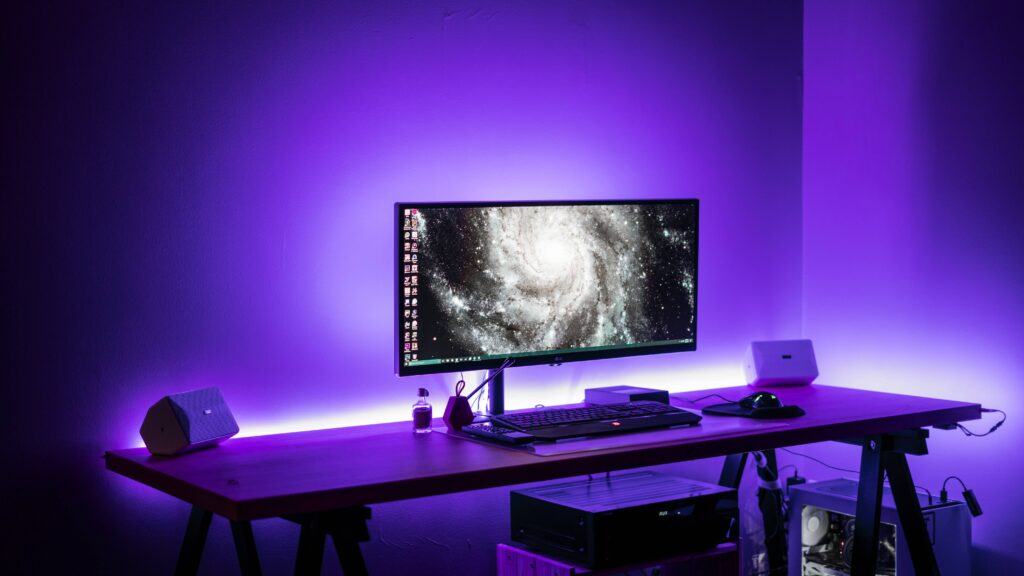
Behind a TV or desk (bias lighting)
A strip on the back of a TV or monitor lights the wall behind it. This is called bias lighting, and it reduces the contrast between a bright screen and a dark room, which can ease eye strain. For accurate picture color, bias lights are ideally neutral white, but in a bedroom at night, a dim, warm setting is gentler.
Around mirrors
LEDs around or on both sides of a mirror light your face evenly, without the shadows a ceiling light creates. That's ideal for makeup, skincare, or shaving. Choose high-CRI (90+) lights around 3000K–4000K so colors look true.
Inside closets, wardrobes, and drawers
Battery or plug-in strips, often with motion or door sensors, light up automatically when you open the door. They make it much easier to see your clothes and keep things organized. Rechargeable motion-sensor bars are a simple option when there's no outlet nearby.
Bedside reading lights
Wall-mounted swing-arm lights or bedside lamps with warm, dimmable LEDs let you read without lighting up the whole room, and without disturbing a partner.
How to Install LED Strip Lights in Your Bedroom
- Plan the layout. Decide where the strips will go and where the power outlet is. Measure each section, and remember that the strip has to start near the power supply or controller.
- Check the length and power. Make sure the strip is long enough, and that the power supply can handle the total length.
- Clean the surface. Wipe it with rubbing alcohol or a damp cloth, and let it dry completely so the adhesive sticks well.
- Cut to size if needed. Unplug the strip and cut only at the marked cut lines.
- Test before sticking. Plug the strip in to make sure every section lights up.
- Stick it down. Peel the backing off a little at a time, pressing the strip firmly into place as you go. Around corners, use corner connectors or gentle curves rather than sharp folds. For rough or painted surfaces, add mounting clips so the strip doesn't sag over time.
- Connect and tidy the wiring. Join any sections with matching connectors or solder, then clip the cables neatly out of the way.
- Set it up. Pair the remote or app, then create your favorite colors, schedules, and a warm "bedtime" setting.
Safety tips:
- Use the power supply that came with the strip, or a properly rated one. Don't overload extension leads.
- Keep the power supply and controller somewhere with airflow, away from bedding and curtains.
- If you're installing new wiring or permanent fixtures that run on mains voltage, have a qualified electrician do it.
Benefits of LED Lighting in the Bedroom
- Lower electricity bills: LEDs use much less power than older bulbs.
- Long life and low maintenance: fewer bulb changes.
- Flexible design: strips, bulbs, panels, and lamps in every shape, color, and white tone.
- Better sleep habits: dimmable, warm, and smart lights make it easy to reduce harsh light in the evening.
- Cool and safe: low heat and no UV make LEDs well suited to soft furnishings and enclosed spaces.
- Instant on: full brightness the moment you switch them on.
- Recyclable: many LED bulbs and fixtures can be recycled at electronics recycling points.