 Ask The Home Geek
It doesn't happen often, but when a microwave's glass turntable cracks or shatters, it can be startling, and it leaves you wondering whether the microwave is still usable.
Here's why microwave turntables break, how to prevent it, whether you can use the microwave without one, and how to find the right replacement.
Why Do Microwave Turntables Break?
The most common cause is thermal shock: a sudden temperature change, such as putting a frozen dish on a hot tray, or rinsing a hot tray under cold water. Other causes include running the microwave with little or no food (so the tray itself gets very hot), drops and knocks that chip the glass, heat from grill or convection modes, and a tray that isn't seated on its coupler. Once a tray is chipped or cracked, it is much more likely to break the next time it heats up.
Common Causes in Detail
1. Thermal shock
Glass expands as it heats and contracts as it cools. When one part of the tray changes temperature much faster than another, the stress can crack or shatter it. Common triggers:
- Putting a frozen or very cold dish on a tray that's still hot
- Washing a hot tray in cold water, or setting it on a cold, wet surface
- Very hot food or oil spilling onto one spot of the tray
2. Running the microwave empty or nearly empty
With little or nothing to absorb the microwaves, more energy goes into the tray and the cavity. The glass can get very hot, especially in the center, which makes cracking more likely. Running the oven empty can also damage the magnetron.
3. Chips, cracks, and knocks
A heavy dish, a drop in the sink, or a knock against the counter can chip the rim. Those chips grow with each heating cycle until the tray breaks. Age alone does not make a sound tray brittle.
4. Grill and convection heat
In grill or convection mode, the heating element can make the tray much hotter than microwave cooking does. The tray is usually designed for that, but extra heat plus an existing chip, or a sudden cooldown, raises the risk.
5. The tray isn't seated properly
If the tray isn't sitting on the roller ring and the coupler (the drive hub in the center), it can wobble, rub, or jam. That stress makes cracks more likely, and a jammed tray can damage the motor.
6. Overloading
A very heavy dish, or a dish much wider than the tray, puts extra strain on the glass, the roller ring, and the motor.
Can You Still Use the Microwave If the Turntable Is Broken?
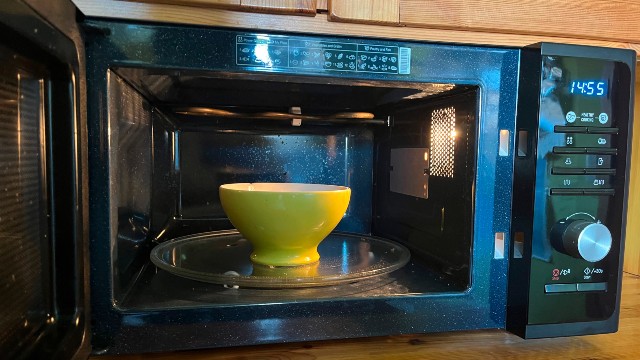
Not with a cracked or shattered tray. Throw the pieces away. A cracked tray can break while it is hot and spill food, and loose glass in the oven is a hazard. Remove the pieces carefully, and check the roller ring and the cavity floor for fragments.
Using the microwave with no tray at all is a different question. Check the manual. Many manufacturers say not to run the microwave unless the glass tray and the roller ring are in place, because:
- The oven was tested with the tray in it
- A dish set on the cavity floor or on the coupler can heat unevenly and spill into the drive
Some models have a "turntable off" setting. That stops the tray from turning so a large dish will fit, but the tray stays in the oven. If the manual doesn't allow cooking with the tray removed, wait for a replacement.
Food also heats less evenly when it doesn't move. The turntable carries food through the oven's hotter and cooler spots. There is more on why a microwave rotates the food.
Flatbed microwaves have no turntable. A hidden antenna, sometimes called a stirrer, spins under the floor and spreads the microwaves around.
A turntable that reverses direction from one use to the next is normal. That is not a sign it is about to break. Here is why microwave turntables switch directions.
Can You Fix a Broken Turntable?
No. Don't glue a cracked tray. Ordinary glue and epoxy are not made for repeated heating. They can soften, crack, or give off fumes, and the seam is a weak spot that can fail while the tray is hot. Replace the tray.
How to Find the Right Replacement Turntable
- Find the model number. It is usually on a label inside the door frame, on the back, or under the microwave. A part made for that model is the safest match.
- Measure the old tray. Replacement trays are often about 9.6 inches (24.5 cm) to 16.5 inches (42 cm) across. Some ovens fall outside that range, so measure yours.
- Check the hub underneath. The center usually has a pattern, often three notches, that has to fit the coupler. The right diameter with the wrong hub will not turn.
- Check the roller ring. Replace it too if it is cracked, warped, or missing, and make sure the new one matches the tray and the oven.
- Match the size before you buy an aftermarket plate. This 9.6-inch Gemroom plate has a small center hole and fits only some small ovens. This 13.5-inch Gemroom plate has a larger center hole. Either one fits only if your old tray is that size and the hub matches. They are not a match for every microwave.
You can also order the tray from the manufacturer or an appliance-parts supplier.
What If the Turntable Won't Spin?
If the glass is intact but the tray doesn't turn:
- Reseat the tray and the roller ring on the coupler.
- Clean the roller ring and the track on the cavity floor. Dried food can make the tray stick.
- Look at the coupler. A worn, cracked, or stripped hub is a small part that can be replaced from outside the oven.
- Check for a turntable on/off setting.
- If none of that helps, the turntable motor under the cavity may have failed. Have a technician replace it. Reaching the motor means opening the case.
Don't open the microwave's outer case yourself. The high-voltage capacitor can hold a dangerous charge after the microwave is unplugged.
How to Prevent Your Turntable From Breaking
- Let the tray cool before you wash it, and use warm water rather than cold.
- Don't set a frozen dish on a hot tray. Let the tray cool, or put a room-temperature plate between the frozen food and the glass.
- Never run the microwave empty.
- Don't knock dishes against the rim, and don't drop the tray in the sink.
- Seat it on the roller ring and the coupler before you start the oven.
- Replace it at the first chip or crack.